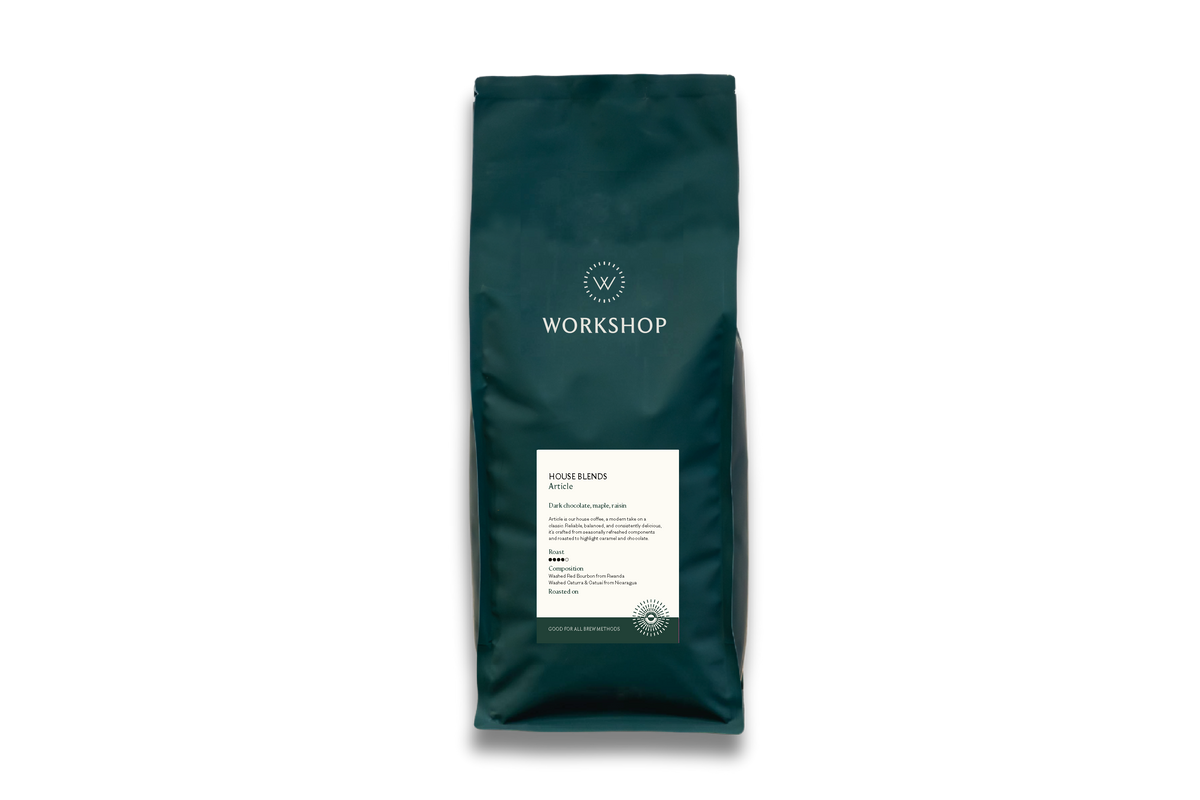
Workshop Coffee
— Article (2kg) |
— Article (2kg) |
Couldn't load pickup availability
Roasted for Espresso & Filter | Dark Chocolate, Maple, Raisin
Article is the name of our house coffee, a high performing, consistent blend offering reliability and a satisfying, classic flavour profile. Components are seasonally refreshed and roasted to accentuate deeper caramels and chocolate tones.
With each iteration we aim to compose a coffee that has great balance, packed with classic coffee characteristics whilst retaining a sweet, clean finish.
Current Composition: |
50% Washed Red Bourbon & RAB C15 from Gitesi in Rwanda
50% Washed Catuaí & Caturra from Jalapa, Nueva Segovia in Nicaragua.
‣ Component Information:
Jalapa, Nueva Segovia, Nicaragua
Having worked in Nicaragua since 2018 we have come to love those complex, dense lots from the higher altitudes of Nueva Segovia, close to the border with Honduras.
Some of the producers in the region whose coffee is making up this community blend are Cleofe Cruz and Efrain Roque. Cleofe tends to the Caturra cultivar at 1,637 metres, whilst Efrain has Catuaí growing at 1,350 metres. They are also growing plantains as a secondary food crop and to provide shade, which is also given by Ingas and other native forest trees. After harvesting both Cleofe and Efrain perform a fermentation stage of around 36 to 48 hours before fully washing the clean coffee parchment.
Comprising ultimately of outturns from smallhold growers such as these, our Nicaraguan coffees come from a slightly more involved supply chain. — Typically in a hot and dry climate, a lot of the effort and potential of great coffees can be undone at the drying stage. Even ripe cherries, processed and handled well, can lose their flavours during transit if they’re dried too quickly or aggressively. | Caravela operate two beneficios dedicated to taking processed parchment through this crucial stage in a very methodical manner. Beneficia La Estrella is their buying and drying hub near Jinotega, where we have enjoyed some very chocolatey and satisfying lots from over the years. Beneficio La Concordia is their facility near Ocotal in the north, where we compile these lots for our perennially available single origin coffee, Evergreen, as well as to use in our house blend, Article. · At each benbeficio they employ a trained team to move coffees from various tiered mesh beds under differing degrees of shade, using specially designed rakes to comb through the drying lots. Relying on tools like hygrometers and thermometers, they can ensure each lot of coffee gets the utmost care during the drying stage. The goal is to capture and retain as much quality as possible.
We pay well in excess of not just the legal minimum price and the living income wage in Nicaragua, but also the minimum prosperity price, ensuring coffee is a viable and sustainable crop for smallhold growers to continue to work with.
— Gitesi, Rwanda
Aime is always hospitable and positive when we visit Rwanda. · We stay in close contact throughout the year to hear how things are going at the washing station. As well as buying and processing coffee cherries grown by the smallholder farmers in the surrounding hillsides, his family also tend to their own small farm. They have a wormery which they use to make an organic fertiliser spray, which also helps to limit the spread of leaf rust. Every year they are buying more land and planting more coffee, with over 20,000 trees now producing on their own farm. Their mature trees produce an average of 5kg fruit per year but can produce upwards of 20kg. They keep bees at the farm, to aid biodiversity and pollination of the coffee trees.
Cows kept at the station provide milk and fertiliser for their own trees, and through Aime’s social work they donate dozens of cows each year to farmers in the local area, as well as spray pumps for fertiliser. They also donate seedlings from their nursery of over 10,000 plants to neighbouring farmers and run workshops to teach them about tending to other food crops as well as coffee. Around 100 of the most vulnerable families are also supported with health insurance each year through working with Gitesi.
The water used for producing washed coffees comes from a natural spring. After being used for processing the coffee it becomes full of particulates and enzymes, needing to be filtered before being reintroduced into the local water table. At Gitesi they collect water from the washing channels as well as run off from the mounds of coffee pulp (which breaks down to provide more compost for their trees) and first hold it in a tank. The mucilage settles and is separated off to be added to organic fertiliser whilst the water passes through lime and EM (effective microorganisms). Subsequent stages use molasses, holding tanks, charcoal and fine gravel to filter the water before it finally passes through a bed of vetiver reeds, re-oxygenating it. This filtration system is highly advanced and is held up as an exemplary model for other washing stations to work towards.
A couple of years ago they built new washing and grading channels at the station as part of their renovations. Typically they will process around 80% of their coffee volumes as washed coffee, with 20% naturals being done on a case by case basis for certain clients.
|
— Aime sees the work at Gitesi as much more than simple crop husbandry and coffee production, doing amazing work within the neighbouring community. We asked him for a message that we could pass along to the people drinking coffee from Gitesi and he replied with the following, that we haven’t the heart to shorten:
“The Gitesi Sector is the land of our grandfathers, it’s where even my father was born. But as you know, because of Rwandan history we grew up outside our country, and we came back in 1994 after the genocide and liberation war. Upon our return we have found in our land no one among our family members, all of them were killed in the genocide. We are now living and working with those who killed (or their children) our relatives. What motivates us is the reconciliation between the survivors of genocide of those who participated in genocide in our sector, now we are working together at the washing station, sharing everything in peace. Our plan is to continue changing the lives of our people at Gitesi both socially and economically.
We continue planting new coffee trees every year to renew older plots and improve productivity, alongside strengthening shade management and soil health practices across more of the farm. The goal is always better quality, healthier trees, and long-term sustainability for the land and the people who depend on it.”
◆ We have plans to continue working with Aime and Gitesi for many years, with a view to diversify our offering by looking at other farm-specific outturns processed at the station, as well as featuring their coffees across our whole coffee menu, from single origin filter and espresso releases to blend components in our house blends.
Share